
Project information
Organisation: TyreSafe and Safer Roads Greater Manchester (SRGM)
Contacts: Stuart Lovatt and Mike Bourne (TyreSafe), Brad Mawson (SRGM)
Contact emails: slovatt@tyresafe.org, mbourne@tyresafe.org, Brad.Mawson@tfgm.com
Case study title: Multi-Agency Enforcement and Education (Operation Considerate & ACT)
Links:
Operation Considerate - Tyre Safety Enforcement in Bolton
Operation ACT - Analysis of Road Safety Enforcement in Bolton
Which Safe System Components does your case study cover?
- Safe Vehicles - This is the primary focal point. The operations ensure vehicles meet legal safety standards, specifically targeting tyre tread depth and structural condition to prevent mechanical failure.
- Safe Road Users - A core pillar of these interventions. By combining enforcement with roadside education and engagement, we directly improve road user knowledge. We treat the stop as a "teachable moment," ensuring the driver leaves with the competence to maintain their vehicle safely in the future.
- Safe Speeds & Safe Road Users - While the focal point is vehicle defects, these operations were conducted as part of broader "Fatal 4" enforcement, addressing speed, seatbelts, distraction, and impairment.
Which Safe System Operators does your case study cover?
- Leadership and coordination
- Legislation and regulation
- Standards and training
- Education and communications
- Compliance and enforcement
- Research, monitoring and evaluation
Please explain how this case study relates to the key principles of the Safe System?
This initiative aligns with the principle that human fallibility is inevitable, but death and serious injury are not. By identifying "dangerous" or "illegal" tyres before a collision occurs, we remove a critical failure point. It treats vehicle maintenance as a preventative element of the Safe System — recognising that a vehicle with defective tyres cannot stop or steer effectively in an emergency, regardless of driver intent.
What did you seek to achieve and how did you go about it?
We sought to bridge the gap between enforcement (penalising illegal tyres) and education (explaining why they are dangerous).
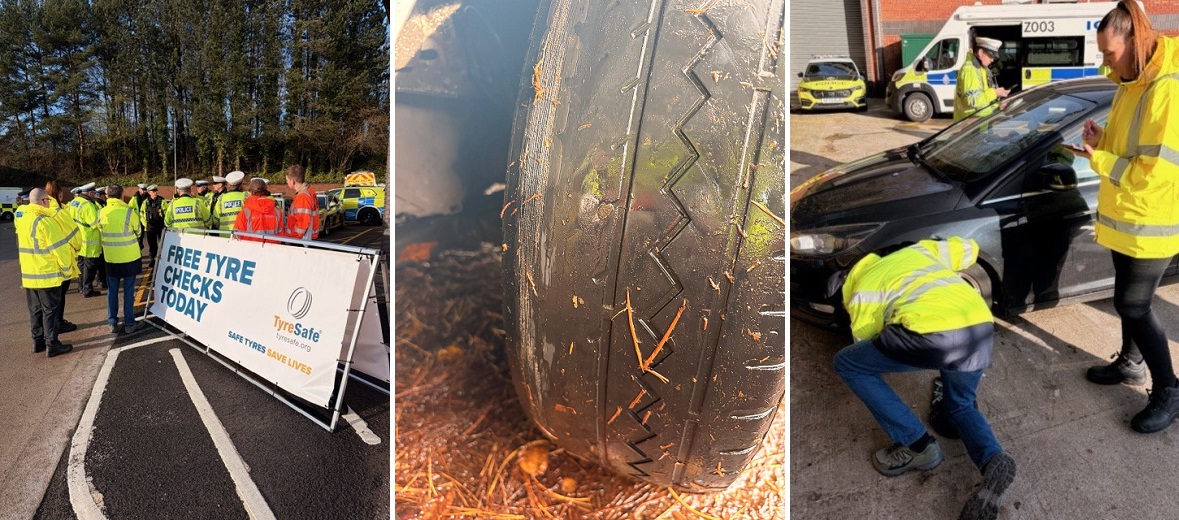
Method - We utilised ‘action days’ where Greater Manchester Police officers intercepted vehicles for roadside checks. While police and DVSA handled the legal enforcement (PG9 notices or Fixed Penalty Notices), TyreSafe and SRGM staff provided immediate roadside education to the drivers, using gauges to demonstrate the danger of their specific tyres.
What were your aims and objectives?
- Reduce Road Risk - Remove unroadworthy vehicles from the Greater Manchester network.
- Data Collection - Use roadside inspections as a "leading indicator" of the state of the nation's vehicle health.
- Behavioural Change - Shift driver perception of tyre checks from a "once-a-year MOT task" to a regular safety habit.
Which other stakeholders and partners were involved?
• Greater Manchester Police (GMP) Transport Unit
• Safer Roads Greater Manchester (SRGM)
• TyreSafe
• DVSA (for technical guidance on vehicle prohibitions)
How are you measuring/did you measure the effectiveness of what you delivered? What results did you achieve?
Effectiveness was measured through immediate enforcement data and longitudinal defect trends.
- Operation ACT (Bolton) - During one intensive period, 47 vehicles were stopped; over 50% were found to have defects. 19 vehicles were immediately prohibited (PG9) from being driven further.
- Operation Considerate (Bolton) - Highlighted that a significant percentage of "Fatal 4" stops also revealed secondary vehicle defects, proving that high-risk drivers often neglect vehicle maintenance.
What challenges did you encounter on the way?
- Resource Allocation - While coordinating multiple agencies for a half day of action requires intensive forward planning, our evaluation proves it to be a highly efficient use of resources. The high volume of safety-critical defects identified per operation consistently justifies the multi-agency investment.
- Public Perception - Some drivers initially view roadside stops as "revenue raising." We countered this by having TyreSafe staff present the safety data directly to the driver, shifting the tone from "punishment" to "protection."
What advice would you give to other organisations seeking to deliver something similar?
- Combine Enforcement with Education - Don't just issue a ticket. Use the moment of the stop to educate. A driver is never more receptive to a safety message than when they are looking at the cord visible on their own tyre.
- Use Data to Target - Focus operations on areas with high MOT failure rates or known collision hotspots to maximise the "hit rate" of unsafe vehicles.
What are the next steps for you and your partners in relation to this initiative?
Following the successful inclusion of the TyreSafe Programme in the Government’s Road Safety Strategy (January 2026), our next steps involve -
- Advocating for Safety Performance Indicators (SPIs) that reflect vehicle maintenance standards.
- Utilising DVSA MOT data as a lagging indicator to predict where future roadside interventions are most needed.
- Scaling this multi-agency template to other UK Road Safety Partnerships.